
A lean that's new, or growing
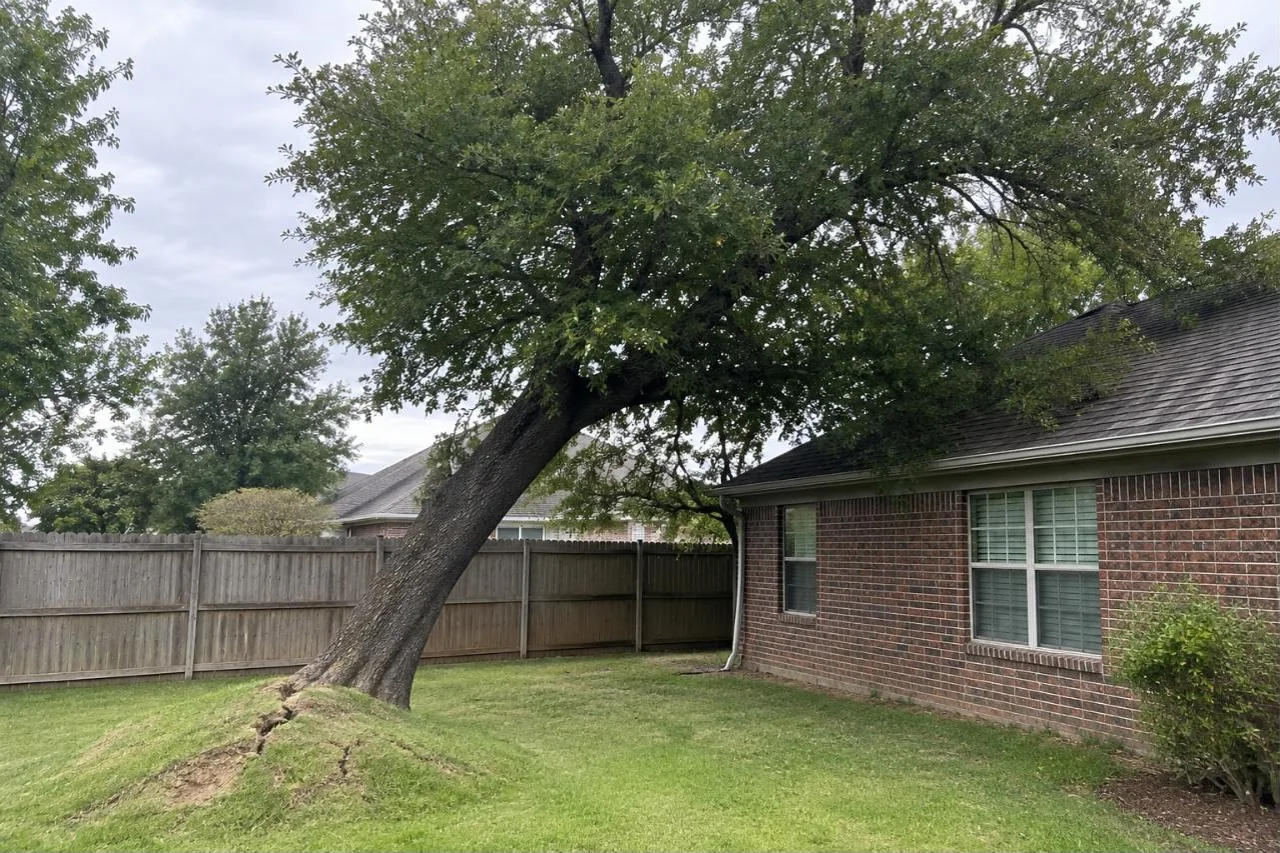
Lots of trees lean from the start, reaching for open sky, and stay put like that for a lifetime. The worrying kind of lean is one that appeared after a storm or keeps getting worse. Signs to look for at the base:
- Soil lifted, mounded or cracked opposite the lean, as if the roots were prying the ground up
- Roots newly exposed, torn or snapped
- A gap opening between the trunk and the soil on the leaning side
- A fence, walk or driveway edge near the roots that has shifted
MSU Extension's storm-damage guide explains why this matters: a large tree pushed over by heavy wind may have lost half or more of its root system, and "Trees larger than 4 inches can be difficult to fully straighten" (checked Nov 11, 2026). A big oak leaning toward the house, with the ground heaved at its base, isn't a candidate for staking. It needs a contractor's look soon.
Soil plays a part. Many soils in northwestern Mississippi's loess have a fragipan, a dense layer in the subsoil. USDA's description of the Grenada series says its fragipan "perches water during wet seasons in late winter and early in spring," and the Loring series reaches its pan 14 to 35 inches down (checked Nov 11, 2026). Roots tend to stay above a layer like that, and that's when ice storms and spring wind arrive. Which soils lie under a particular yard wasn't confirmed for this site.
Pines turning yellow, then brown
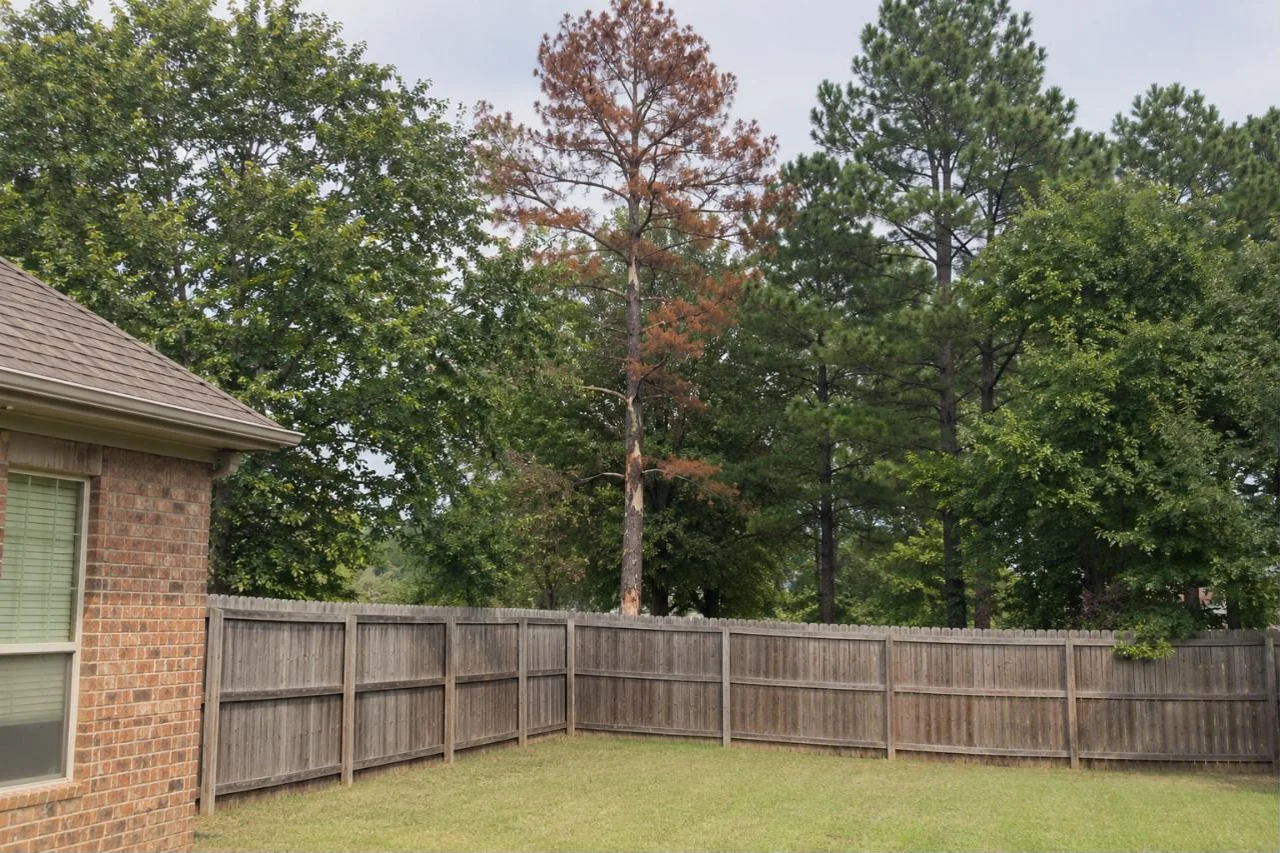
When a pine's whole crown goes rust-brown, it's almost always too late. MSU Extension describes how bark beetle attacks show up, from first sign to last (checked Nov 11, 2026):
- Pitch tubes: "dried, white balls of sap that look like popcorn stuck to the bark of the tree."
- Yellowing needles at the top of the tree, and boring dust piling up at the base.
- A red or brown crown, with bark starting to slip off. By then, MSU says, "the damage is long done, and the tree is dead."
"All five species are always present, but Ips are of special concern for drought-stressed trees," MSU notes. After the 2023 drought, the Mississippi Forestry Commission's February 2024 pine mortality report estimated "over 12,500,000 dead trees" across the Mississippi area it surveyed. The state's 2024 forest health report found southern pine beetle activity elevated, mainly in central and northeastern Mississippi, with "a northward increase in SPB activity across the state" and "statewide elevated activity from Ips engraver beetles" (all checked Nov 11, 2026). Neither report names DeSoto County.
A dead pine near a house, a fence or a play set is a removal job. Ask the contractor to look at the pines next to it too; beetles that finished one tree may have started on another.
Oaks shedding bark in strips
Hypoxylon canker, which MSU Extension's Plant Doctor sheet calls Biscogniauxia (Hypoxylon) dieback, is the oak disease to know in Mississippi. The sheet lists water, southern red, white, live and post oaks among its hosts and says "All oaks are susceptible," particularly the red oak group (checked Nov 11, 2026). What to look for:
- Bark sloughing off "in patches or long strips"
- A fungal layer underneath that turns silvery-gray and, as it ages, black
It's a disease of stressed trees, and in Mississippi outbreaks often appear "a year or two following a significant drought." MSU is blunt about the outcome: "There is no treatment for hypoxylon," and "Severely infected trees should be cut and burned. Ideally, the stumps should be destroyed, as well." Burning isn't allowed inside DeSoto County's cities, so in town that means removal, grinding the stump, and hauling the wood away.
Leaves browning from the edges in summer
Bacterial leaf scorch is caused by the bacterium Xylella fastidiosa, spread by sap-sucking insects such as leafhoppers and spittlebugs. MSU Extension lists oak, elm, sycamore, maple, sweetgum and pecan among its hosts (checked Nov 11, 2026). "Usually, leaf symptoms first appear in late spring and early summer," and they're worse in hot, dry weather.
"An infected plant can never be cured of leaf scorch." MSU suggests removing an infected tree only when it becomes a hazard. Oxytetracycline, available to commercial applicators, can reduce symptoms but doesn't cure the tree (checked Nov 12, 2026). In pecans, infected trees "will not produce as many nuts."
Ash trees and the emerald ash borer
Emerald ash borer reached Mississippi in 2025. It was found in Issaquena County in July 2025 and confirmed by the Mississippi Forestry Commission, according to MSU Extension (checked Nov 11, 2026). Nothing read for this site confirms it in DeSoto County. The signs MSU lists: "yellow, thin or wilted foliage, unusual woodpecker presence and pecking holes," "D-shaped beetle exit holes," and "shoots growing from roots or a tree's trunk." For trees worth saving, "Stem injections are the most effective and need to be administered by professional applicators"; MSU puts that at about $100 to $250 for a medium landscape tree, repeated every one to three years. Don't move firewood.
Trees hurt by ice
After Winter Storm Fern in January 2026, MSU's forestry newsletter sorted ice-damaged pines into two groups: "Slightly damaged trees retain a good number of limbs and have stem lean of no more than 45 degrees," while "Severely damaged trees have few remaining limbs or lean greater than 45 degrees" (checked Nov 11, 2026). Among hardwoods, MSU Extension says 'Bradford' pears have close, upright branches that often split in strong winds, and it lists the Callery pear's "Weak wood susceptible to cracks, branch breakage, and stem splitting during storms."
Keep people out from under any broken limb still hanging in a crown until it's down.
Signs that call for a look soon
| What you see | What it can mean |
|---|---|
| Popcorn-like pitch on pine bark, sawdust at the base | Bark beetle attack (MSU Extension) |
| Pine needles yellow at the top, then red-brown | The tree is dying or dead |
| Oak bark falling off in strips, gray or black underneath | Hypoxylon canker; no treatment (MSU Extension) |
| Leaf edges brown every summer, worse in drought | Possible bacterial leaf scorch; incurable |
| A new or increasing lean, soil heaved at the base | Root failure; may have lost half its roots (MSU Extension) |
| A crack through a fork, or a split trunk | A weak union that may fail in the next wind or ice |
| Large dead limbs over the roof or driveway | Limbs that can drop without warning |
Do dead trees need a city permit?
On an ordinary house lot, no: Southaven exempts residential lots of one acre or less, and Horn Lake and Hernando exempt residential parcels under one acre. Olive Branch's tree rules apply to development plans (checked Nov 11 and 12, 2026). Southaven also exempts trees "injured or destroyed during acts of God" (zoning code Sec. 13-11, checked Nov 11, 2026). On a larger lot in Horn Lake or Hernando, the permit covers "protected trees," and whether a dead tree counts wasn't confirmed for this site, so ask the city's planning office first. The tree rules guide has the phone numbers.
Questions about dying trees
Can a pine with a few pitch tubes be saved?
MSU's sequence starts with pitch tubes and yellowing needles at the top; by the time the crown turns red or brown, it says, the tree is dead. Have a pine with pitch tubes looked at while it's still green.
Can I take down a small dead tree myself?
A small one in open ground, perhaps. MSU Extension reminds homeowners that "Removing tree limbs is dangerous work," and anything near the house, a fence or a wire is a job for a crew with the right equipment.
Will my insurance pay to remove a dead tree that hasn't fallen?
This site didn't find an official Mississippi source on that; ask your agent. The Mississippi Insurance Department does tell homeowners to "trim or remove damaged trees and limbs" before hurricane season (checked Nov 11, 2026).
Whatever you send through this site reaches a single independent contractor working in DeSoto County. The site doesn't inspect or diagnose trees.
Sources
- MSU Extension, Foresters expect bark beetle risk to rise in spring (Feb 5, 2024; updated Aug 8, 2025); Mississippi Forestry Commission, 2024 Pine Mortality Report; USDA Forest Service and MFC, Mississippi Forest Health Highlights 2024. Checked Nov 11, 2026.
- MSU Extension, The Plant Doctor: Biscogniauxia (Hypoxylon) Dieback of Oaks, Caterpillar, fungus affects drought-stressed trees, Bacterial Leaf Scorch and Emerald ash borer has arrived in state (Nov 25, 2025). Checked Nov 11, 2026.
- MSU Extension, Repairing Storm-damaged Shade, Ornamental, and Fruit Trees, The Overstory, May 2026 and Non-native and Native Yard Trees in Mississippi and Callery Pear. Checked Nov 11, 2026.
- MAFES, Soil Resource Areas of Mississippi; USDA NRCS, Grenada and Loring series. Checked Nov 11, 2026.
- City of Southaven zoning code, Sec. 13-11, on Municode (Supp. No. 70, read Nov 12, 2026), and Horn Lake's tree removal permit application, checked Nov 11, 2026; Hernando Code Chapter 16 and Olive Branch Code Appendix A, checked Nov 12, 2026; Mississippi Insurance Department, Weather Disaster, checked Nov 11, 2026.