
Who does what kind of work
Not every company with a chainsaw is set up for every tree. Roughly:
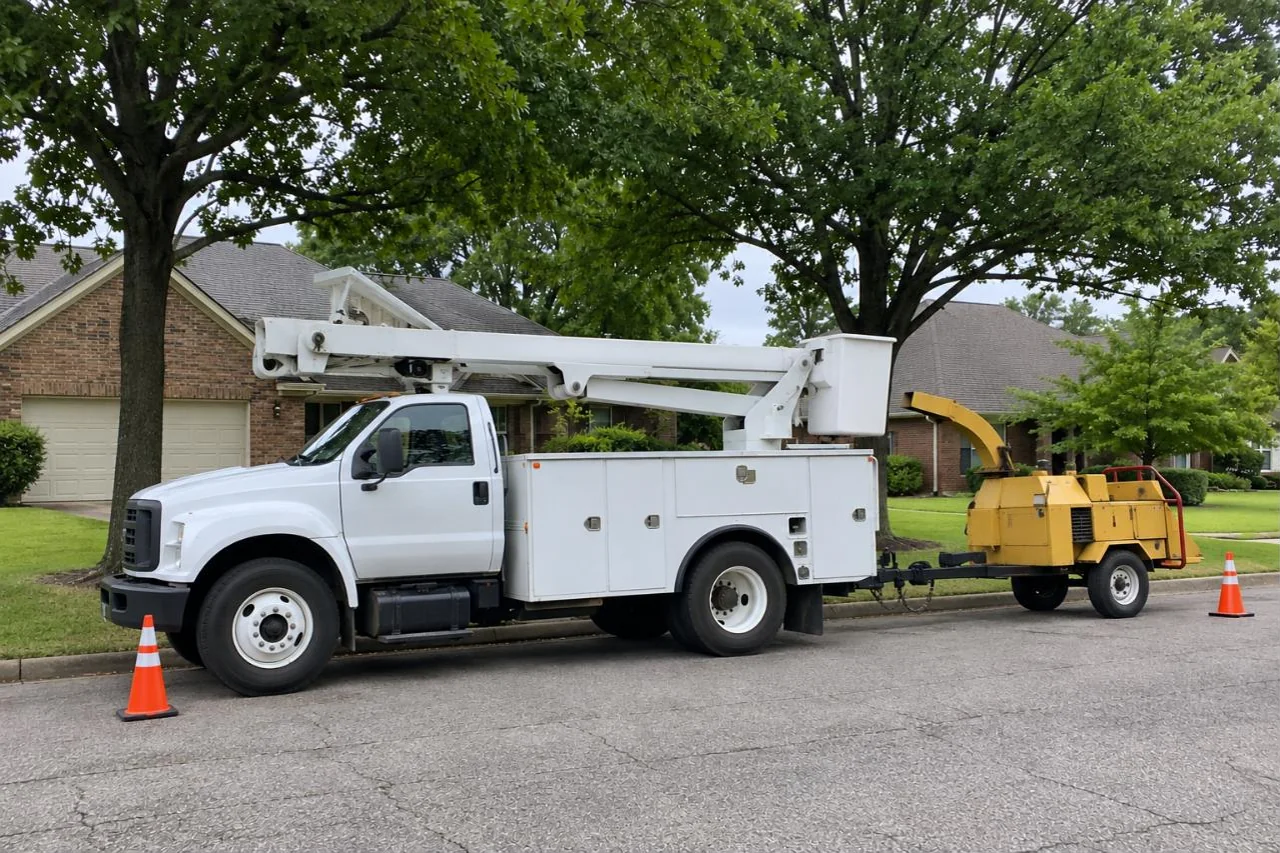
- A tree service brings climbers, rigging, a bucket truck, a chipper and a stump grinder, and sometimes hires a crane. A big oak or pecan over a house, a tree near the wires, or a split trunk after an ice storm is this kind of work.
- A lawn or landscape crew handles shrubs, small ornamental trees and low limbs that can be reached from the ground.
- Land clearing is a different trade again: acreage, heavy machines, and piles that are ground or, outside city limits, burned under the county's separate commercial permit.
Describe the job honestly when you call, including what's under the tree. It saves a wasted visit.
Questions to ask at the visit
The contractor should walk around the tree, look up into the crown, and look at what's underneath. Good questions while they're there:
- How will it come down? Felled whole, taken down in sections by a climber or from a bucket truck, or lifted out by crane?
- Where will each big piece land, and what protects the roof, the patio cover, the fence and the lawn?
- How will the equipment get in? Through the gate, over the curb, across the lawn? If the ground is soft, what happens to the ruts?
- Are any wires involved? Mississippi law requires arrangements with the utility before work that could come within 10 feet of a high-voltage line (Miss. Code §§ 45-15-3 and 45-15-9). On Entergy's system, the service line running to your house is the owner's responsibility, and Entergy can disconnect it while the work is done (checked Nov 11, 2026). Who makes that call?
- Who opens the 811 ticket for the stump? The law puts it on the excavator, the person doing the digging, with three to ten working days' notice (checked Nov 11, 2026).
- Does the city need to be involved? Not on a typical house lot. On a larger property in Southaven, Horn Lake or Hernando, or in a Hernando historic district, ask who checks with the city and who files any paperwork. The tree rules guide lays out each city's line.
- What happens to the wood? None of the four cities collects debris from tree services (checked Nov 11, 2026). Chipped and hauled? Logs left for firewood? Brush left at the curb is yours to deal with.
- When can it be done, and how long will it take?
What the agreement should say
The Attorney General's storm guide asks for "a written contract that details the work to be done, materials to be used," "a payment schedule that is based on completion of work, and a timeline for work to be completed." It adds, "Get a guarantee in writing. Do not accept verbal agreements." The Mississippi Insurance Department says the same thing more briefly: "Get a written copy of the agreed upon amount before the work begins" (both checked Nov 11, 2026).
For tree work, a useful agreement lists:
| Item | What to look for |
|---|---|
| The trees | Each tree identified by where it stands, and whether it's removed or trimmed |
| The method | Sections, bucket truck or crane, if that affects price or your yard |
| The stump | Ground or left, and roughly how far below grade |
| Cleanup | Chipping, hauling, raking; which logs, if any, stay |
| Damage | What happens if a fence panel, gutter or sprinkler head is broken |
| 811 and wires | Who requests the locate and who deals with the power company |
| Permits | On larger lots only: who files and who pays the city's fees |
| Price and payment | The total, the deposit if there is one, and the date the rest is owed |
| Timing | A start date or window and how long the job should take |
Paying for the work
The Attorney General's advice on money, quoted from its storm guide (checked Nov 11, 2026):
- "Do not pay in full up-front."
- A deposit, where one is required, "should not exceed 10% or 25% of the total cost of the job."
- "Pay by check or money order and keep a receipt."
- "Write all checks to the company, not an individual worker."
- "Be wary of door-to-door repair solicitations or people who demand deposits or payments in cash."
The Mississippi Insurance Department adds, "Be wary of contractors who demand upfront payment before work is initiated." If an insurance claim is involved, keep every receipt; MID says receipts for tree and debris removal help you get "properly reimbursed by their insurance company."
Canceling a deal signed at your door
Federal rule. The FTC's Cooling-Off Rule covers sales made at your home, workplace or dorm (not sales under $25 at home). "Your right to cancel for a full refund lasts until midnight of the third business day after the sale," and Saturdays count as business days. The seller must give you a dated contract and two copies of a cancellation form. The rule doesn't cover sales "needed to meet an emergency" or repairs you asked the seller to come and do (FTC page dated September 2025, checked Nov 11, 2026).
Mississippi law. The Home Solicitation Sales Act (Miss. Code § 75-66-1 and following) covers credit sales made through a personal solicitation at your home. The buyer may cancel "until midnight of the third business day" after signing; the notice goes in writing to the seller's address, and a certified or registered letter counts once it's properly mailed. The seller may keep a cancellation charge of up to 5% of the cash price, but not more than the down payment. Emergency work you asked for, once the seller has in good faith substantially begun, is excluded (checked Nov 11, 2026).
Write down the date and time you signed, and keep a copy of everything you were handed.
After a storm
The Attorney General's storm guide warns about door-to-door solicitations after storms. Mississippi's price-gouging law (Miss. Code § 75-24-25) applies to services sold in a declared emergency area and holds prices to what was ordinarily charged in the same market just before the declaration, plus necessary costs. The Attorney General's guide describes gouging as charging "exorbitant and unjustified prices" for goods or services "that disaster victims have little choice but to buy," and asks people to report it. The Consumer Protection Division takes calls at 1-800-281-4418 and complaints online; its main office is 601-359-3680 (checked Nov 11, 2026).
If the tree hit the house, photograph the damage and call your insurance company before permanent repairs. The storm guide has the full order of steps.
Trees near the property line
Mississippi takes cutting a neighbor's tree seriously. Under Miss. Code § 95-5-10, cutting someone else's tree without consent costs double its fair market value plus reforestation costs, and more if it was willful or reckless; an "honest mistake" is no defense (checked Nov 11, 2026). If the trunk is on or near the line, get the neighbor's agreement in writing and show it to the contractor.
Warning signs
- Cash only, or full payment before any work
- No written agreement, or a refusal to put cleanup and the stump in writing
- Pressure to sign on the spot after a storm
- No answer about where the pieces will land or how the wires will be handled
- Vague answers about the wood: "we'll leave it at the curb" in a city that won't collect it
Hiring questions
How much deposit is reasonable?
The Attorney General's guide says a deposit, where required, "should not exceed 10% or 25% of the total cost of the job" (checked Nov 11, 2026).
The crew wants to leave the brush at the curb for the city. Will the city take it?
No. Southaven, Olive Branch, Horn Lake and Hernando all say they don't collect debris from tree services (checked Nov 11, 2026).
I signed with someone at my door this morning and changed my mind. What now?
Send written notice of cancellation before midnight of the third business day, keep a copy, and mail it in a way you can prove. The FTC rule and Mississippi's law for credit sales both apply that deadline, with exceptions for emergency work you requested.
Each request made here is passed to a single independent contractor working in DeSoto County, and any agreement for work is between you and that contractor alone.
Sources
- Mississippi Attorney General, A Consumer's Guide: Tips for Storm Victims and Consumer Protection Division. Checked Nov 11, 2026.
- Mississippi Insurance Department, Weather Disaster (modified June 20, 2024). Checked Nov 11, 2026.
- FTC, Buyer's Remorse: The FTC's Cooling-Off Rule May Help (September 2025); Miss. Code § 75-66-1, § 75-66-3, § 75-66-5 and § 75-24-25. Checked Nov 11, 2026.
- Miss. Code § 45-15-3, § 45-15-9 and § 95-5-10; Entergy, tree trimming and how Entergy trims; Mississippi 811 law. Checked Nov 11, 2026.
- Southaven Public Works; Olive Branch Roadside Rubbish Guidelines; Horn Lake Collection Guidelines; Hernando Brush Services. Checked Nov 11, 2026.