
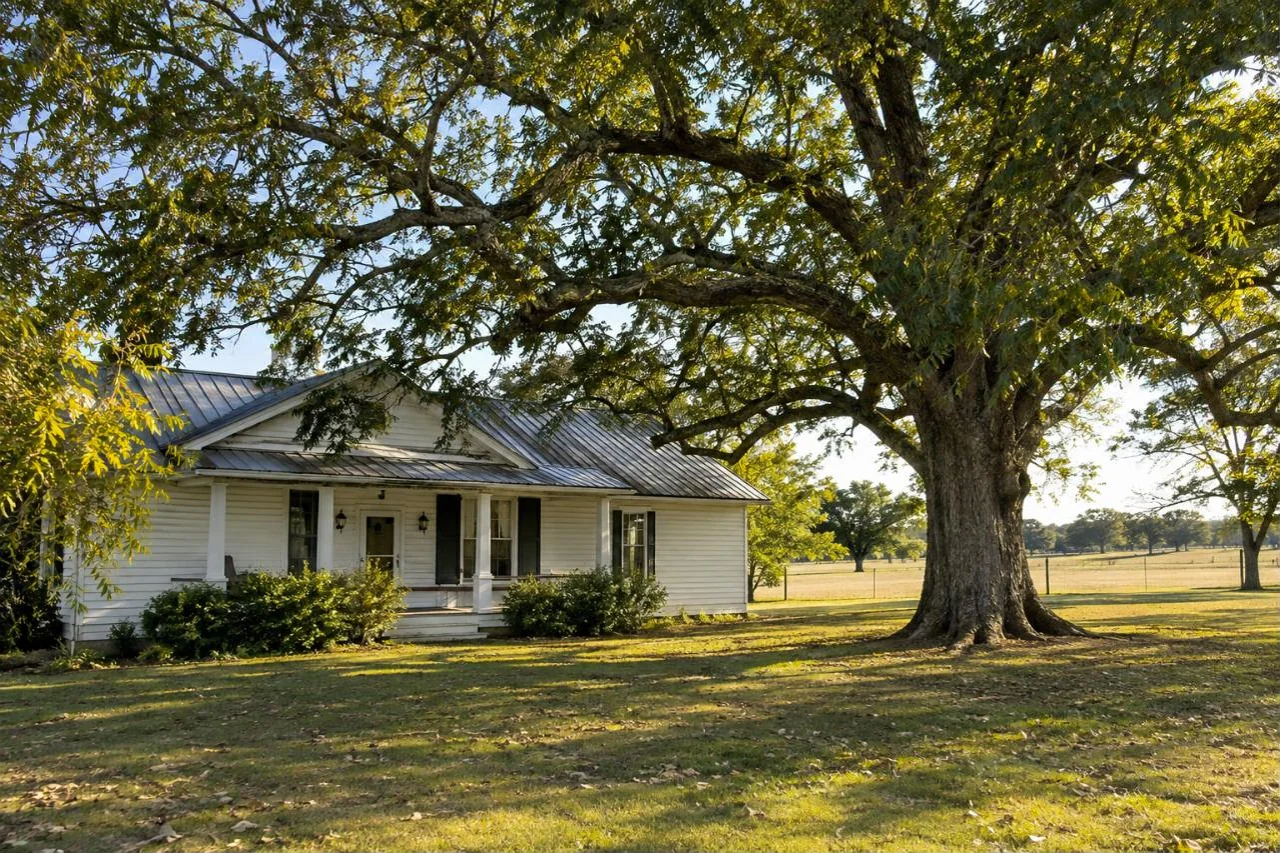
A tree that belongs here
Pecan is native to this part of the country. The USDA Forest Service's Silvics of North America says pecan "grows principally in the lower Mississippi Valley," with its range reaching "eastward to western Mississippi and western Tennessee," which takes in DeSoto County's corner of the state (checked Nov 11, 2026). It "grows commonly on well-drained loam soils which are not subject to prolonged flooding" and "rarely grows on low and poorly drained clay flats."
Pecans get old and thick. Silvics reports trees occasionally reaching 70 to 83 inches in trunk diameter at breast height, and for how long a pecan keeps bearing nuts, "a maximum of 300 years has been reported." On good loam, height growth "averages about 90 cm (35 in) per year for several years." MSU Extension's home-landscape sheet says young trees add 2 to 4 feet of new growth a year, and its summary is simple: "Pecan trees eventually get very large" (checked Nov 11, 2026).
Too big for where it was planted
MSU recommends planting pecans 50 to 75 feet apart, in full sun and well away from buildings and other large shade trees. A pecan planted beside a house or a drive decades ago ignored that advice, and that's where most removal questions start:
- Limbs over the roof. A wide crown means long horizontal limbs, and some of them end up over shingles, a carport or a neighbor's yard.
- Sticky drip. Aphids feeding in the crown drop honeydew, and sooty mold grows on it. MSU names the targets: sidewalks, cars and houses beneath the tree.
- Twigs on the lawn. Twig girdlers cut off small branches that drop into the yard, and fall webworms and walnut caterpillars feed in the crown. These are nuisances, not reasons on their own to remove a tree.
Wind, ice and pecans
The University of Florida's study of trees through hurricanes ranks species across the Southeastern Coastal Plain. Pecan landed in the lowest wind-resistance group, alongside water oak, southern red oak and Bradford pear (UF/IFAS FR173, checked Nov 11, 2026). Those ratings come from hurricane observations, not from DeSoto County, and the authors point out that no tree is wind-proof; soil, care, health and age all play a part.
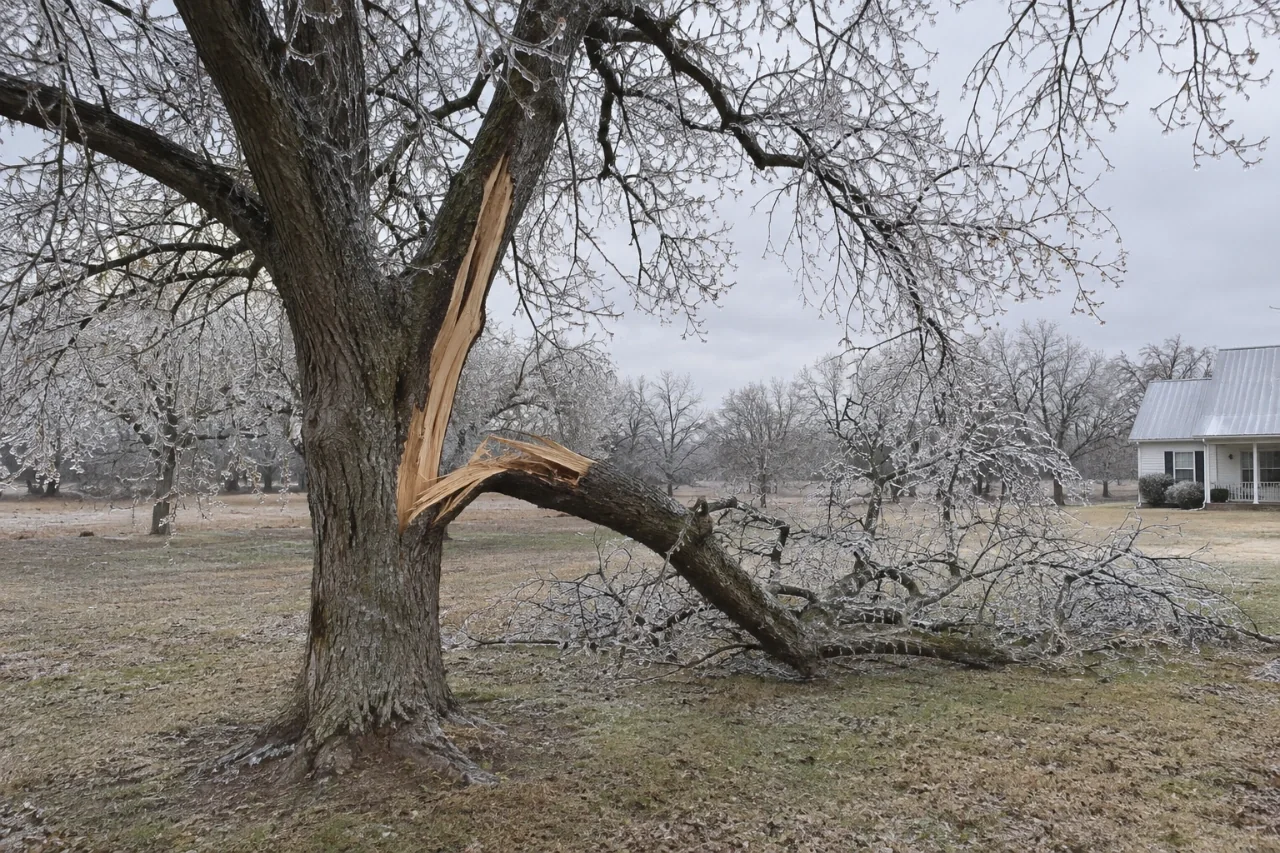
Ice has hit Mississippi pecans hard before. During the February 1994 ice storm, the National Weather Service office in Jackson reports, 25% of Mississippi's pecan crop was destroyed, with pecan losses estimated at $5.5 million per year (checked Nov 11, 2026). That's a crop figure, not a count of fallen trees. DeSoto County was in that storm's federal disaster declaration, DR-1009, and Mississippi's hazard plan counts 44 winter storm events in the county from 1996 to 2022, more than in any other county in its table.
A big limb split out of the trunk, like the one above, leaves an open wound and an unbalanced crown. Whether the tree can keep going depends on how much of it is left and where it stands. MSU's storm-damage guide notes that the same damage weakens a big tree more than a small one, and that "In many cases, the damaged tree will have to be removed and replaced."
Diseases and insects
MSU Extension's guide to pecans in home landscapes (Publication 3967, checked Nov 11, 2026) is realistic about what a homeowner can treat:
- Pecan scab is the most economically important disease. Home fungicide programs generally aren't practical, so MSU tells homeowners to rely on resistant varieties.
- Bacterial leaf scorch has no cure and no resistant cultivars, and infected pecans "will not produce as many nuts."
- Bunch disease (witches' brooms), crown gall, powdery mildew and leaf dieback also show up.
- Insects: pecan weevil, twig girdlers, fall webworms, walnut caterpillars, stem phylloxera, aphids, stink bugs and hickory shuckworm. For twig girdlers, MSU's advice is to pick up and destroy the fallen twigs.
Spraying a mature tree is mostly off the table. Hose-end sprayers reach about 20 feet and 12-volt ATV sprayers about 25, and MSU notes that "concerns about drift and safety issues often preclude spraying large trees even if equipment is available."
Keep it or take it down?
A healthy pecan with room to spread is worth keeping. Removal makes sense when the hazard is real, which is how MSU frames storm-damaged trees in general. Some guideposts:
| Usually worth a closer look | Usually a nuisance, not a hazard |
|---|---|
| A crack or split where big limbs meet the trunk | Twigs dropped by twig girdlers |
| A large limb broken by ice and still hanging | Webworm tents in the crown |
| Decay, hollows or fungus on the trunk | Sooty mold on the car |
| A new lean, or heaved soil at the base | A light nut crop or scabby nuts |
| Heavy limbs over the bedroom end of the house | Leaf litter in fall |
If it's a close call, pruning out the worst limb over the house and taking dead wood out of the crown may be enough for now. The trimming guide covers that.
How a big pecan comes down
A pecan with a wide crown next to a house is almost always taken apart from the top. The long limbs come off first, cut by a climber or from a bucket truck and lowered over the roof on ropes, and then the trunk is cut down in sections. Where a split limb hangs over the house or the tree is too damaged to climb, a crane may lift pieces out; HomeGuide adds $500 to $2,500 a day for crane work (checked Nov 11, 2026).
Silvics says pecan wood "has good machining properties, resembling those of true hickories." If you'd like to keep trunk sections or split firewood, say so before the job, because it changes what the crew hauls. Remember that Southaven, Olive Branch, Horn Lake and Hernando won't collect wood a tree service cut (checked Nov 11, 2026), so whatever you don't keep has to leave with the crew.
The stump and those deep roots
MSU says pecan roots can reach 6 to 10 feet down, and nursery trees are planted with 2 to 3 feet of taproot. Grinding takes the stump and the top of the root flare below the lawn; it doesn't pull out the taproot, and HomeGuide notes that grinding "does not include root removal." A pecan stump is often wide, and grinding is priced by diameter, so measure it. The grinder's operator should have a Mississippi 811 ticket first, placed three to ten working days ahead (checked Nov 11, 2026). The stump grinding guide has the full price table.
Permits and replacement lists
On a residential lot of an acre or less in Southaven, or a residential parcel under an acre in Horn Lake or Hernando, there's no city tree permit for removing a pecan. Olive Branch's tree rules apply to development, and the unincorporated county has no homeowner tree permit (checked Nov 11 and 12, 2026). On larger land, the tree rules guide explains what each city asks for. Pecan doesn't appear on either of the replacement-tree lists in Southaven's zoning code, the acceptable list or the unacceptable one (Sec. 13-11, checked Nov 11, 2026).
If you plant another one
MSU lists Cape Fear, Forkert, Kiowa, Owens and Jackson as pecan varieties for Mississippi, with Sumner, Elliott and Melrose for south Mississippi only. Plant it 50 to 75 feet from other pecans and well away from the house, in deep, well-drained soil (MSU Extension, checked Nov 11, 2026).
Pecan questions
What does it cost to take down a big pecan?
No national guide gives a pecan price. HomeGuide's removal figures by height run $650 to $2,000 for a tree 60 to 80 feet tall and $1,200 to $2,700 above 80 feet (checked Nov 11, 2026). A wide crown over a house, a crane or hauling the wood pushes a job up. What matters is the written price for your own tree.
My pecan drops sticky residue on the car. Does it need to come down?
Not for that alone. MSU traces the sticky drip and the black film to aphid honeydew and sooty mold. It's a nuisance, not a sign the tree is failing.
Ice split a big limb off my pecan. Can the rest of the tree be saved?
Sometimes. It depends on how much of the crown is left, whether the trunk is cracked, and what's underneath. A contractor can look at the wound and the balance of what remains.
Pecan calls and forms from this site are routed to one independent contractor in DeSoto County. The site doesn't cut, prune or treat trees.
Sources
- USDA Forest Service, Silvics of North America, Pecan (J. K. Peterson). Checked Nov 11, 2026.
- MSU Extension, Fruit and Nut Review: Pecans in the Home Landscape (IS1432), Disease and Insect Management for Pecans in Home Landscapes (P3967), Bacterial Leaf Scorch and Repairing Storm-damaged Shade, Ornamental, and Fruit Trees. Checked Nov 11, 2026.
- UF/IFAS, Wind and Trees: Lessons Learned from Hurricanes (FR173); NWS Jackson, 1994 ice storm; FEMA, DeSoto County declarations; MEMA, State Hazard Mitigation Plan, Section 3.9. Checked Nov 11, 2026.
- City of Southaven zoning code, Sec. 13-11, on Municode (Supp. No. 70, read Nov 12, 2026); Horn Lake tree removal permit application; DeSoto County Zoning Ordinance, checked Nov 11, 2026. Hernando Code Chapter 16 and Olive Branch Code Appendix A, checked Nov 12, 2026.
- HomeGuide tree removal cost, tree trimming cost and stump grinding cost; Mississippi 811 law. Checked Nov 11, 2026.